The county code exempts single-family residences from stormwater permitting — but Volusia County only governs unincorporated areas. If you live in Daytona Beach, Port Orange or Ormond Beach, your city's rules apply. Here's the breakdown, with the actual code sections cited.
For a typical single-family home in Volusia County, a French drain on your own property generally does not require a county stormwater permit — Land Development Code §72-777(b)(1)(a) expressly exempts single-family and duplex residences. But that answer is incomplete, because the county's rules only govern unincorporated areas. If your home is inside Daytona Beach, Port Orange, Ormond Beach, New Smyrna Beach, DeLand or Deltona city limits, your city's rules apply — and the most common trigger is not the drain itself but where the water discharges.
The two-layer rule most advice gets wrong
Most articles about Florida drainage permits talk about county or water-management-district thresholds — Environmental Resource Permits, retention requirements, engineered plans. Those rules exist, but they are written for developments, not for a homeowner fixing a flooded side yard. Volusia County's own flooding FAQ states the county is responsible for stormwater 'only in unincorporated areas of the county.' Inside city limits, the city governs. So the practical question is not 'what does Volusia County require?' — it's 'what does MY city require, and does my project touch anything public?'
What the county code actually says
- §72-777(b)(1)(a) — single-family and duplex residences and their accessory structures are exempt from the stormwater permit requirement
- §72-777(b)(1)(f) — one-time construction not exceeding 1,000 square feet of impervious area is exempt
- §72-777(b)(3) — no exemption allows harmful erosion of soil or fill onto adjacent public or private property
- §72-779(a)(1)(d) — drainage systems must not adversely impact downstream owners or adjacent lands
- §72-779(a)(2)(a) — larger 'lesser development' projects must retain runoff equivalent to one-half inch of depth over the project area
Translation: the county is not interested in your residential French drain — until your water becomes someone else's problem. The erosion and downstream-impact rules apply to everyone, exempt or not. That is why discharge design matters more than trench design for staying legal.
City by city: where the real rules live
| City | Your own yard | The common trigger |
|---|---|---|
| Port Orange | Generally no stormwater permit for residential lot work | Right-of-way construction permit (city code Chapter 58) for any work in the ROW — e.g., a discharge line to the street. Engineering: (386) 506-5538 |
| Ormond Beach | Generally no permit for lot drainage | Driveway/culvert work has its own submittal through the city; swale changes along the road involve the city |
| Daytona Beach | Generally no permit for lot drainage | Work touching city right-of-way, sidewalks, or the city storm system goes through the city's permit desk |
| New Smyrna Beach | Generally no permit for lot drainage | The city runs its own stormwater program; coastal lots should confirm discharge points with the city |
| DeLand / Deltona | Generally no permit for lot drainage | Deltona's platted swale system is city-maintained — filling or altering a swale is where homeowners get in trouble |
| Unincorporated Volusia | County code applies — single-family exempt per §72-777(b)(1)(a) | Erosion or discharge affecting neighbors or county drainage easements |
The swale rule nobody reads until it's a problem
Many Volusia subdivisions were platted with roadside swales as the neighborhood's actual drainage system. Homeowners fill them, pipe them, or regrade them for a cleaner-looking yard — and that is one of the most common causes of chronic street and yard flooding we see. It can also put you on the wrong side of your city's public works department, because that swale is usually part of the public drainage design. If your drainage plan involves a swale along the road, confirm with your city before touching it.
Where your water is allowed to go
- A roadside swale or approved storm inlet — usually with the city's blessing if you connect to it
- A low area on your own property far from structures, via pop-up emitter or open discharge
- Never against a neighbor's lot line — §72-777(b)(3) and basic Florida surface-water law both cut against you
- Never into a septic drain field — you'll flood your own system
- HOA communities: architectural review may apply to visible drain boxes and emitters, and HOA retention ponds have their own rules
How we handle it on real jobs
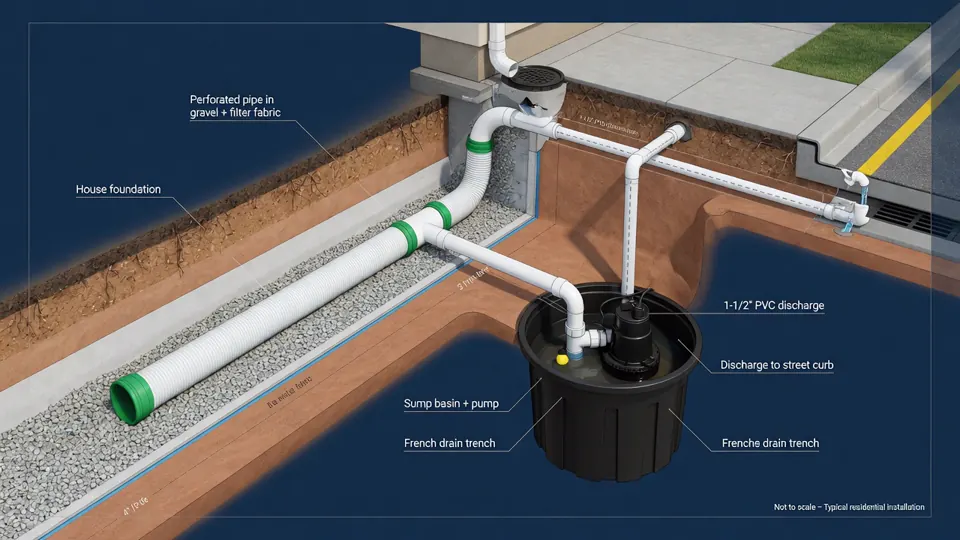
FloGuard designs the discharge path first, then the drain. On every assessment we identify where water can legally and physically go — swale, storm connection, or safe on-lot release — before we design the trench that feeds it. When a project touches a right-of-way, we handle the city conversation. That is the part of drainage work homeowners least expect and the part most likely to cause trouble when it's skipped.
Code sections cited are from the Volusia County Land Development Code, Chapter 72, Division 8 (Stormwater Management), as published August 2026. Rules change and cities apply their own processes — for your specific project, confirm with your city's permit desk, or [book a free assessment](/contact) and we'll walk the discharge path with you. Related: [what a system costs](/blog/french-drain-cost-central-florida-2026) and [how the install process works](/process).
Frequently asked questions
Do I need a permit for a French drain in Volusia County?
For a typical single-family home, generally no county stormwater permit is required — Volusia County Land Development Code §72-777(b)(1)(a) exempts single-family and duplex residences. But county rules only apply in unincorporated areas; inside city limits, your city's rules govern, and work in a public right-of-way usually needs a city permit.
Does Port Orange require a permit for drainage work?
Work on your own lot generally doesn't need a stormwater permit, but anything in the public right-of-way — like running a discharge line to the street — requires a right-of-way construction permit under city code Chapter 58. Port Orange Engineering can confirm: (386) 506-5538.
Can I discharge my French drain onto my neighbor's property?
No. County code §72-777(b)(3) prohibits harmful erosion onto adjacent property, and §72-779(a)(1)(d) requires drainage that does not adversely impact downstream owners. Discharge must go to a swale, approved outlet, or your own lot at a safe distance.
What if I'm adding a patio or driveway with my drainage project?
The county's exemption for small projects covers one-time construction up to 1,000 square feet of impervious area (§72-777(b)(1)(f)). Beyond that, thresholds for 'lesser development' review can apply — that's when a permit conversation starts.
Who handles drainage complaints — the city or the county?
Volusia County's own flooding FAQ says the county maintains stormwater only in unincorporated areas. Inside Daytona Beach, Port Orange, Ormond Beach, New Smyrna Beach, DeLand or Deltona, call your city's public works or stormwater department.
Standing water on your property?
Book a free, on-site drainage assessment. We'll map the problem and design a system built for Florida storms.